
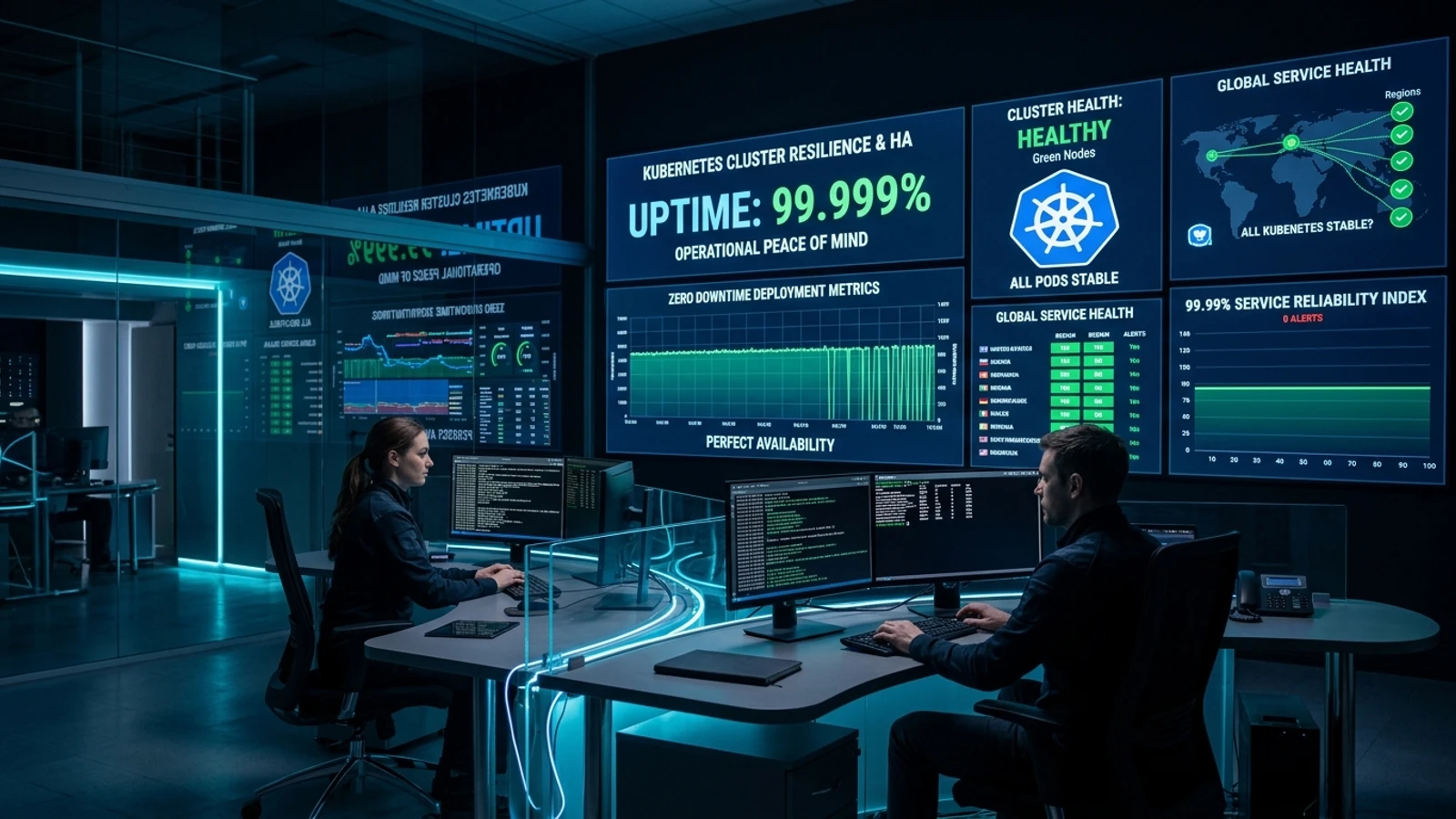
Kubernetes shouldn't give you mini-heart attacks. Learn to interpret alerts, metrics and logs to operate your cluster and handle incidents with context.
Context and overview
Knowing how to deploy a cluster is not the same as knowing how to operate it.
Kubernetes can provide scalability, resilience, and a consistent way to run applications. But it also introduces a considerable operational surface.
When everything works, it seems simple.
The problem arises when a pod goes into CrashLoopBackOff, a node stops responding, an application hits its memory limits (OOMKilled), or an update starts degrading production.
At that moment, the question is not whether the team knows how to run kubectl commands.
The question is:
Can they quickly interpret what is happening, evaluate the impact, and recover the service without making the situation worse?
That is where the little Kubernetes mini-heart attacks usually happen.
Kubernetes rarely fails without leaving signs. The real problem is how long it takes the team to turn those signs into context and that context into a safe decision.
Installing Kubernetes is just the beginning
A production-ready cluster needs much more than just workloads running correctly.
It needs an operation designed around:
requests and limits);livenessProbe, readinessProbe, startupProbe) properly configured;PodDisruptionBudgets) and tested scaling;RBAC) and security policies;# QoS Guaranteed resource contract in Kubernetes
apiVersion: v1
kind: Pod
spec:
containers:
- name: api-service
resources:
requests:
cpu: "250m"
memory: "512Mi"
limits:
cpu: "1000m"
memory: "512Mi" # Same value as request to avoid arbitrary OOMKilledWithout these capabilities, Kubernetes can become a technically sophisticated but operationally fragile platform.
And fragility almost never shows up during the demo.
It shows up when traffic spikes, a dependency fails, an incorrect configuration is introduced, or the only person who knows the cluster is unavailable.
Avoiding incidents doesn’t mean promising they will never happen
No serious platform can guarantee that there will never be an incident.
What can be done is reduce:
A mature operation is not measured solely by uptime.
It is also measured by the ability to respond in an orderly manner when something stops working.
This requires answering uncomfortable questions in advance:
If these answers are not clear, the problem is not just Kubernetes.
It is the operating model.
Auditing is not just pointing out errors
At Nubyron, when we review a Kubernetes platform, we don’t look to generate an endless list of technical recommendations.
Our job is to identify what prevents the platform from being operated with confidence.
We review the architecture, workloads, scaling, deployments, observability, security, costs, and recovery capabilities.
Then we prioritize.
Because not every finding has the same importance, and not every improvement should be applied at the same time.
The result must be an executable plan:
We recently performed exactly this work: we came in, reviewed the platform, identified the main risks, and delivered a prioritized solution.
From there, an important reality arrives:
An audit can show the way, but it does not modify production on its own.
The final decision and execution remain on the organization’s side.
That is why a technical recommendation only generates value when there is ownership, priority, and capacity to apply it.
The risk of having a report that nobody executes
Many organizations know some of their problems:
But the day-to-day always wins.
New features, commercial commitments, incidents, and delivery dates arrive. Platform improvement gets postponed again.
Until the incident occurs that turns a pending recommendation into an urgency.
That is why, after an audit, there must be:
It’s not enough to close the ticket saying the recommendation has been delivered.
You have to close the risk.
KubeBolt as an operational accelerator
Within this approach, tools like KubeBolt can considerably reduce friction during diagnosis and response.
KubeBolt is building an AI-assisted operations platform for Kubernetes. Its approach covers the cycle of detection, diagnosis, remediation, verification, and subsequent incident documentation. It currently offers audited manual operations, assisted resolution via Kobi, and an Autopilot mode in beta for autonomous remediations under policies and guardrails.
Its value is not simply in showing more metrics.
Kubernetes already generates abundant information.
The value lies in helping answer questions sooner, such as:
KubeBolt can query the cluster state, correlate signals, propose actions, and maintain traceability of changes. Its proposal also includes generating postmortem drafts based on the incident timeline.
For Nubyron, this represents an accelerator.
It allows us to:
But there is an important distinction.
KubeBolt does not replace a correct architecture, good configuration, or a clear operating model.
A tool can help you diagnose an OOMKilled, but the team still needs to understand why those resources were defined, what impact modifying them has, and how to prevent the problem from repeating.
Automation accelerates the operation.
Technical judgment remains essential.
Test before trusting
At Nubyron, we don’t incorporate a tool into a client’s operation simply because it works well during a demo.
We try to break it.
We subject it to anomalous scenarios, imperfect configurations, and situations where available information is incomplete.
We want to verify:
Our priority is for the client to be able to focus on developing and growing their product.
To achieve this, the operational layer we place behind it must be rigorously validated.
KubeBolt helps us streamline that validation and reduce the time needed to gain context within Kubernetes. Its evolutionary model—from visibility and assistance to autonomy under policies—also allows adopting the tool progressively, initially keeping a human in the loop.
Autonomy must arrive in stages
Allowing a tool to act autonomously on production demands trust.
And trust is not activated with a button.
It is built gradually:
KubeBolt follows exactly an evolution from assisted operations to Autopilot with policy controls, auditing, and deterministic execution.
This approach is much more responsible than trying to automate any incident from day one.
How Nubyron helps
Nubyron can intervene at different points in the lifecycle of a Kubernetes platform. If you are still deciding whether to adopt it, move workloads or upgrade versions, see Kubernetes: adoption, migration and upgrades.
Operational audit
We review the platform and detect risks in: architecture, resources, scaling, deployments, observability, security, backups, costs, continuity, ownership.
Improvement plan
We turn findings into a prioritized backlog, with impact, owners, and acceptance criteria.
Implementation
We can apply the agreed-upon improvements: Terraform, Helm, CI/CD, observability, alerts, policies, backups, runbooks, security, optimization.
Continuous Operations
When the scope requires it, Nubyron can assume the maintenance and recurring operation of the infrastructure.
Tool Validation
We test solutions like KubeBolt before incorporating them into client scenarios, evaluating not only their ease of use but also their security, traceability, and behavior during failures.
Conclusion
Working with Kubernetes is not just about knowing how to deploy applications.
It is about knowing how to keep them operational when they stop behaving as we expect.
A reliable platform needs three elements:
Nubyron provides the architecture, judgment, and operations.
KubeBolt helps us accelerate diagnosis, response, and subsequent learning.
The goal is not to ensure an incident never happens.
The goal is that, when it does happen, nobody has to improvise with an elevated heart rate in front of a terminal.
You build the product. Nubyron operates the infrastructure.
Does your team operate Kubernetes with confidence, or do they depend on the right person always being available?
At Nubyron, we can review the architecture, prioritize risks, and help you turn the cluster into a more observable, recoverable, and maintainable platform.
Tell us how you are operating Kubernetes.
Is there something in your infrastructure that is not working as it should?
Tell us what is happening and we will see where to start. No sales pressure.
NEXT STEP
Review your Kubernetes operations
Kubernetes is part of our DevOps operations when it fits your platform. We agree the scope and schedule before starting.
See managed DevOps and operations