
It is 11:47 AM.
A developer is working on a client’s database.
They need to clean up a few records.
They run a query.
And a few seconds later, the message appears:
“I think I just deleted a production table.”
Silence.
Then come the questions.
When was the last backup?
Where is it stored?
Is it complete?
How long will it take to restore?
Are we going to lose everything that happened since early this morning?
Do we have binary logs enabled?
Are they working?
Has anyone ever tested a restore?
And probably the most uncomfortable question of all:
Do we actually have a backup strategy, or do we just have a scheduled cron job that claims to take backups?
Those are two very different things.
Human error is also part of production
When discussing data loss, we usually imagine extreme scenarios:
- Ransomware attacks;
- Hardware or disk failure;
- An entire cloud region going down;
- Data corruption;
- Security breaches;
- Severe infrastructure downtime.
Yet many critical incidents begin in a far less cinematic fashion.
DELETE FROM customers;when you intended to execute:
DELETE FROM customers
WHERE id = 12345;
Or a:
DROP TABLE orders;executed against the wrong database.
Or a migration script that contained unexpected destructive behavior.
Or an automated script executed against production instead of staging.
Nobody needs to be incompetent for this to happen.
All it takes is an open terminal, sufficient privileges, and a momentary lapse in concentration.
This is why a backup strategy should not be designed solely around the premise that “a server might break.”
It must also account for something much simpler:
People make mistakes.
Having backups does not mean you can recover
This is arguably one of the most dangerous misconceptions in operations.
Someone asks:
Do we have backups?
And the response is:
Yes, they run every night.
Great.
Now come the questions that actually matter.
When was the last time you tested a restore?
How long did it take?
Did you verify that the recovered data was valid and consistent?
Do you know exactly how much data you would lose if an outage occurred right now?
Because a backup file sitting somewhere in object storage is not yet a recovery strategy.
It might be incomplete.
It might be corrupt.
The credentials required to access it might no longer work.
The restore procedure might be completely undocumented.
It might take six hours when the business expects to restore service within thirty minutes.
It might even restore cleanly… except the last available backup is 23 hours old.
At that point, the question is no longer:
“Do we have backups?”
It becomes:
“Can we recover the service and data to the exact point the business requires?”
That is the only problem that truly matters.
Early morning backups are rarely enough
Suppose you take a full database backup every night at 02:00 AM.
At 15:36 PM, someone accidentally deletes a critical table.
You can restore the 02:00 AM backup.
However, you just discovered a secondary catastrophe.
The database state will revert back to 02:00 AM.
What happens to all operations performed during the intervening 13 hours and 36 minutes?
- New customers created.
- Orders and transactions processed.
- Invoices generated.
- Configuration changes applied.
- Critical user-submitted records.
In some non-critical systems, losing a few hours of data might be tolerable.
In transaction-heavy platforms, it can be fatal.
This is why Point-in-Time Recovery (PITR) mechanisms exist.
MySQL Binary Logs: the small files that can save your business
In MySQL, there is an indispensable mechanism for these scenarios: the binary log, commonly referred to as binlog.
MySQL records all data modification events in these files.
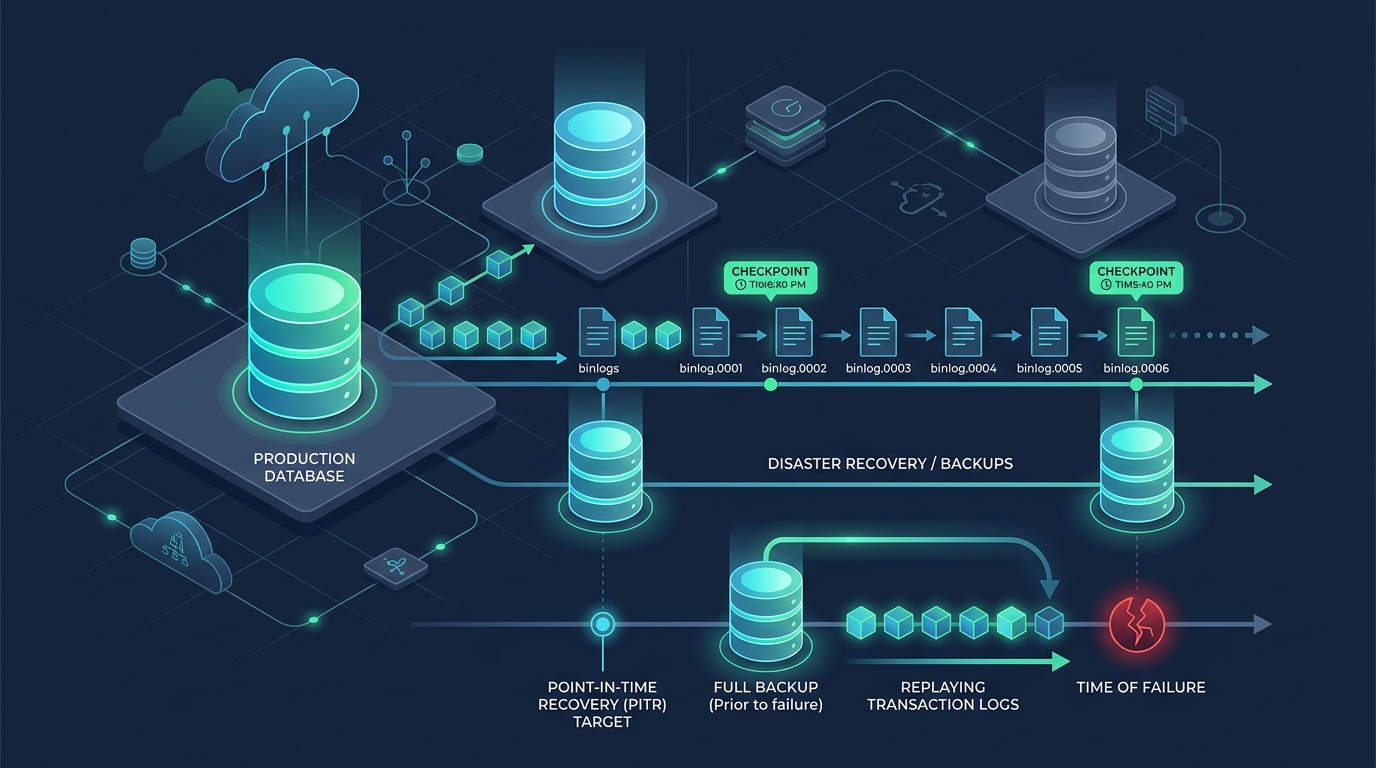
This allows you to take a full base backup as a starting point, and subsequently replay the recorded transaction events up to a specific millisecond or position. MySQL officially documents this exact combination of full backups and binary logs to perform point-in-time recovery.
Consider this timeline:
- 02:00 → Full backup completed
- 02:00–15:36 → Continuous changes recorded in binary logs
- 15:36:42 → Destructive operation executed
Instead of accepting the loss of everything since 02:00, you can execute a recovery target up to:
15:36:41
Exactly one second prior to the disaster.
Conceptually:
Full Backup + Binary Logs → Database state immediately before the incident
Binary logs allow you to select the events you want to replay by timestamp or exact log position (stop-datetime or stop-position).
That turns a business-threatening crisis into a manageable operational incident.
However, there is an important caveat.
Binary logs do not replace base backups
Binlogs should never be treated as “I no longer need regular backups.”
Point-in-time recovery requires a consistent full backup as its foundation, after which logs are applied sequentially to reconstruct incremental changes.
You need both pillars of the strategy.
And you must ensure both are stored resiliently.
If your host fails and both your base backups and binary logs reside solely on the lost volume, your strategy had a fundamental flaw from day one.
Managed cloud databases still require active configuration
Using a managed cloud database service does not eliminate operational responsibility.
Services like Azure Database for MySQL provide built-in Point-in-Time Recovery within a configured retention window by combining automated full backups and transaction logs.
Google Cloud SQL and AWS RDS offer equivalent PITR mechanisms.
However, the fact that the feature exists does not mean it is configured to match your recovery requirements.
You still need to evaluate:
- Retention windows,
- Backup frequency,
- PITR availability across replicas,
- Storage redundancy (geo-redundant vs local),
- Encryption and key management,
- Access control and IAM permissions,
- Downstream dependencies,
- Actual restoration duration,
- And documented operational runbooks.
Clicking “Enable automated backups” is the start of the conversation, not the end.
RPO and RTO: two metrics that matter when data is lost
Every engineering team and stakeholder should be able to answer two fundamental questions.
RPO — Recovery Point Objective
How much data is the business willing to lose?
If you only perform once-daily backups, your potential data loss exposure is up to 24 hours.
With automated snapshots, replication, and properly configured Point-in-Time Recovery, that window can be compressed down to seconds.
Your RPO should never be discovered during a post-mortem.
It must be agreed upon beforehand.
RTO — Recovery Time Objective
How long can the service afford to stay down during a restore?
You might have a pristine backup.
However, if restoring it requires:
- Locating the right archive;
- Downloading hundreds of gigabytes over the network;
- Provisioning a new database instance;
- Replaying transaction logs;
- Recreating users and access permissions;
- Updating connection strings and secrets;
- Validating data consistency;
- Updating DNS records or load balancers;
- And doing all of this by deciphering outdated documentation from two years ago…
You may technically possess a backup, but operationally you have an unresolved downtime crisis.
“Backup completed successfully” proves very little
Seeing this line in your dashboard:
Backup completed successfully
provides false comfort.
It only proves that an automated export process exited with code 0.
It does not prove that you can rebuild your operational service.
The only reliable proof is executing regular restoration drills.
In an isolated environment.
On a scheduled basis.
With validated end-to-end results.
A valid recovery test should answer, at minimum:
- Can the archive be restored without schema or decompression errors?
- How long does the full restoration take?
- Is data integrity verified after restore?
- Can we restore precisely to the expected point in time?
- Are all configuration secrets and environment variables accessible?
- Is the recovery runbook clear and up to date?
- Can an engineer other than the original architect execute the procedure?
- Does the restoration satisfy your defined RPO and RTO?
Because the worst time to learn how to restore a database is when production is already down.
Never restore directly over production if you can avoid it
Here is another critical operational rule.
When accidental data loss happens, the instinct is often to overwrite production as quickly as possible.
Restoring directly onto the affected production instance introduces unnecessary risk.
Whenever feasible, restore the backup or execute PITR onto an independent, isolated instance.
This approach allows your team to:
- Reconstruct the exact state prior to the incident;
- Audit exactly which tables or records were affected;
- Verify that the recovered data is intact;
- Extract only the missing records or affected tables if appropriate;
- Safely re-import or merge the data into production.
This prevents a single human mistake from compounding into a cascading disaster.
Replicas are not backups
Another frequent misunderstanding:
We have read replicas / HA failover, so our data is safe.
High availability and backups solve completely different problems.
If someone runs:
DROP TABLE customers;and your replication pipeline works perfectly…
You now have a high-performance replica where customers is also gone.
Replication protects against infrastructure node failure.
Backups and Point-in-Time Recovery protect against logical corruption, software defects, and accidental data deletion.
A resilient cloud architecture requires both layers.
The only strategy that matters is the one you can execute under pressure
A robust operational backup policy should include, at minimum:
- Automated backups: No reliance on manual intervention or memory.
- Defined retention policies: 7, 30, or 90+ days aligned with compliance and business requirements.
- Point-in-Time Recovery: Essential for active production databases with ongoing write traffic.
- Fault-domain separation: Backups must reside in an isolated storage bucket or separate account/subscription.
- Active alerting & monitoring: If a backup fails tonight, the team should know tonight—not four months later.
- Periodic restoration testing: Automated drills and dry runs wherever possible.
- Step-by-step Runbooks: What to restore, from where, in what sequence, who has permissions, and how to validate.
- Clear RPO and RTO targets: Defined in real minutes and hours, not vague intentions.
Run a check this week
There is a simple question that immediately exposes the resilience of any cloud infrastructure.
Ask your engineering team:
If someone accidentally drops our most critical production table right now, to what exact point in time can we recover, and how many minutes will it take?
If the answer is clear and documented:
Excellent.
If the answer begins with:
“In theory…”
It is time to audit your recovery setup.
And if nobody knows where the backups are stored:
You just found your top priority for the week.
Backups are invisible until the day they aren’t
Nobody celebrates a quiet backup job.
Nobody writes in Slack:
“Another great Tuesday where we didn’t have to restore the production database.”
It is silent infrastructure.
Until someone executes the wrong command.
When that happens, verified backups, active binary logs, configured PITR, and battle-tested runbooks make the difference between a minor incident and catastrophic business disruption.
A tense hour.
A bit of cold sweat.
And a good story to tell afterward.
Instead of frantic customer calls, lost revenue, and irreversible data loss.
At Nubyron, we help engineering teams audit and harden these exact pillars: cloud maintenance, infrastructure audits, operational continuity, disaster recovery and platform reliability.
Because the ultimate question is never whether your servers take backups.
It is this:
Are you 100% certain you could recover tomorrow?