
Technology budgets at Spanish companies are set to grow. The important question is what will remain after the money has been spent.
A study by Var Group and Excellera Intelligence reports that 82% of the surveyed Spanish companies expect to increase their digital transformation budgets. Artificial intelligence is among the leading areas for future investment, alongside cloud and data management. Cybersecurity remains the immediate priority for 61%.
The figures reflect a widespread conviction: 98% consider a digital transformation strategy important and 93% associate it with the ability to compete. Yet a strategy is not a list of technologies, and a larger budget does not guarantee a better transformation.
Between approving an investment and producing a business result sit architecture, integration, security, data, talent and operations. This middle ground is where promising plans become pilots that never scale, platforms that are difficult to maintain, or costs that grow without an equivalent measure of value.
What the 82% figure actually says
The scope of the finding matters. The online survey covered 309 European companies with annual revenue above €10 million. The Spanish sample consisted of 100 industrial and services companies.
The result is therefore a relevant signal from medium-sized and large companies. It cannot be extended without qualification to freelancers, microbusinesses or the entire Spanish economy. Nor does it mean that 82% will specifically increase AI spending: they expect to increase their digital transformation budget, and AI is one of their priorities.
That distinction matters. A headline can suggest a race to buy models or deploy agents. The study describes a broader shift:
- cybersecurity continues to command immediate attention;
- cloud and AI are gaining weight as innovation platforms;
- data analysis and management stand out as future investment priorities in Spain;
- integration with legacy systems remains the main barrier;
- security vulnerabilities and internal resistance to change slow adoption.
Moreover, 59% of the Spanish respondents believe they have invested more in ICT solutions and digital transformation than comparable companies in their sector. Competitive pressure is already present. The risk is mistaking investing first for creating value first.
Investment intent is moving faster than the ability to scale
Other recent research helps frame the difference between ambition, adoption and results.
The KPMG Global Tech Report 2026 found that 81% of the Spanish organisations surveyed are already investing in the adoption of AI agents. While 65% say their use cases are generating value, only 23% achieve returns across multiple use cases. At the same time, 67% acknowledge that they lack the talent required to execute their digital transformation strategy.
Adoption across a broader business population offers a different perspective. According to the Bank of Spain’s analysis of its Survey of Business Activity, published in 2025, approximately 20% of companies were using AI and most users were still in an experimental or pilot phase. Cloud penetration had reached 44% and showed a more mature usage profile.
The samples and methodologies are not directly comparable. That is precisely why the contrast is useful: the investment intentions of higher-revenue companies do not represent adoption across the whole market, and adopting a technology does not mean scaling it with a return.
Cloud is no longer the destination; it is the operating foundation
During the first phase of digital transformation, moving to cloud could be presented as an objective in itself. It now makes more sense to treat cloud as the platform on which data, AI, resilience and security come together.
The Eraneos 2026 Spanish Cloud Market Report, based on responses from more than 100 technology and digital leaders at large companies, estimates that cloud investment will exceed €8 billion in 2026, 17% more than in 2025. Of the organisations surveyed, 58.8% already use generative AI or machine learning in production on cloud, while another 29.4% plan to do so in the coming months.
The report also shows why the discussion is no longer a simple choice between a datacentre and the cloud: almost eight in ten respondents operate hybrid or multicloud architectures, and six in ten store more than half their data in cloud environments.
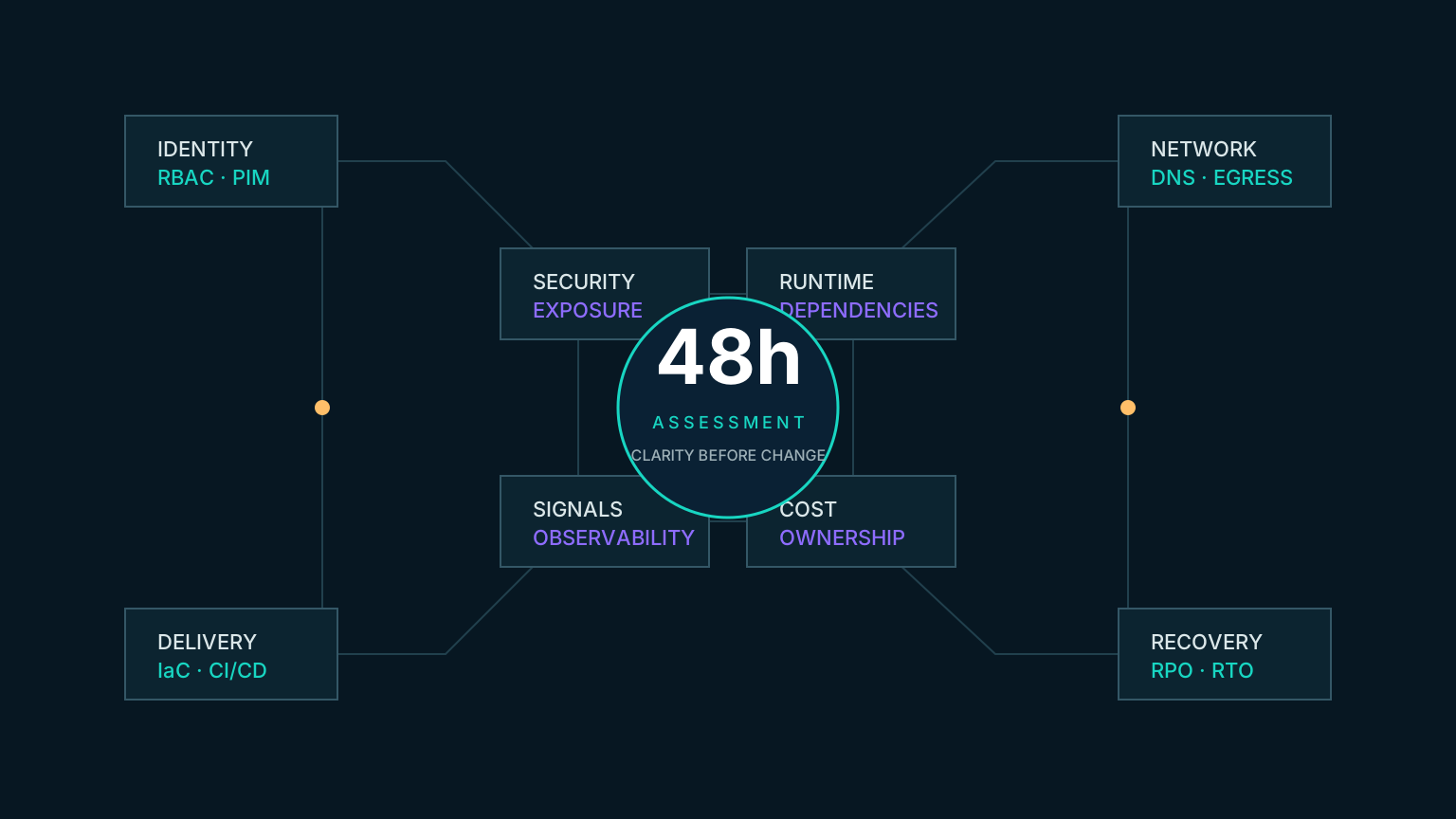
This maturity introduces a different kind of complexity. A company must do more than decide what to migrate and why. It has to govern identities, data, cost, suppliers, observability, recovery and lifecycle management across a distributed environment. Moving a legacy system without addressing its dependencies may change its location without improving its ability to evolve.
AI, cloud, security and data are one architecture decision
Splitting the budget into four independent programmes often produces four platforms that somebody will later have to connect.
An AI use case needs reliable data, controlled access, compute capacity, application integration and a way to observe quality, latency and cost. Security must establish who accesses the data, for what purpose and through which supplier chain. Cloud provides elasticity and managed services, but also introduces new permissions, dependencies and consumption models.
A local decision therefore propagates:
AI use case
  → data and quality
  → identity and permissions
  → infrastructure and network
  → integration and deployment
  → observability and cost
  → governance and operations
If these elements are designed at the end, a pilot may work and still be impossible to deploy safely. Data is copied without traceability, credentials become too broad, manual processes proliferate, bills become unpredictable, or a model emerges that nobody knows how to update without interrupting the service.
The priority should be a shared capability: a foundation on which teams can take use cases into production through repeatable controls. That includes data-access patterns, pipelines, infrastructure as code, secrets, telemetry, security policies, consumption limits and ownership.
Turning the new budget into durable capability
Before allocating money by technology, investment should be organised around outcomes and constraints.
1. Select a small number of verifiable outcomes
“Adopt AI” is not an outcome. Reducing incident-resolution time, improving conversion in a sales process or lowering error rates in an operation are outcomes. Each initiative needs a baseline, a target, an owner and a date on which the company will decide whether to scale, correct or stop it.
2. Fund the foundation shared by multiple use cases
Cataloguing data, resolving identity, automating deployment or building observability may be less visible than an AI demonstration. Without that foundation, each pilot pays for integration again and creates another exception. An explicit part of the budget should build reusable capabilities.
3. Treat security as a design requirement
Cybersecurity being a priority for 61% is consistent with the risk introduced by a larger digital surface. Security, however, should not appear as a review immediately before production. Data classification, least privilege, traceability, third-party management and incident response must form part of the architecture from the beginning.
4. Reserve budget for operations
The cost of an initiative does not end at implementation. Models, databases, pipelines and controls require monitoring, updates, support and recovery. If the budget covers only the initial project, the organisation creates an asset without funding its lifecycle.
5. Make unit cost visible
The total bill explains very little. Teams should know the cost per transaction, document processed, prediction, customer or environment. FinOps practices connect consumption to value and reveal when successful adoption is eroding margin.
6. Invest in adoption and technical judgement
Resistance to change and a shortage of talent cannot be fixed by purchasing another tool. Training, enablement, documentation and internal communities require reserved capacity. Organisations also need the judgement to reject use cases whose risk, cost or complexity exceed their expected benefit.
A scorecard that goes beyond budget consumed
A transformation should not be considered healthy simply because it spends according to plan. A useful scorecard would combine four kinds of signal:
| Dimension | Question | Example measures |
|---|---|---|
| Business | What outcome changed? | revenue, cycle time, satisfaction, errors avoided |
| Adoption | Is usage sustained? | active users, frequency, processes completed |
| Operations | Can it be sustained? | availability, latency, incidents, recovery time |
| Economics and risk | Does value justify cost and exposure? | unit cost, margin, access, exceptions, operational debt |
These metrics make a difficult but necessary decision possible: stopping an attractive pilot that does not solve a sufficiently valuable problem. Cancelling early is also a return because it releases budget and attention before an experiment becomes a dependency.
The 82% creates both an opportunity and an obligation
More companies being willing to invest is a positive signal. Cloud, cybersecurity, data and AI can improve productivity, resilience and the ability to launch new services. The advantage, however, will not belong to whoever announces the most initiatives. It will belong to those that turn them into secure, measurable and operable systems.
The budget should buy something more durable than licences and pilots: the ability to make better decisions, deploy safely, learn from data and retire what does not work.
Before committing a new allocation, an architecture and technology-roadmap review can answer three questions: which outcome deserves investment, which capabilities are missing, and which operational risk the company will assume when the project reaches production.
Spending more will become commonplace. Integrating better will remain the differentiator.