
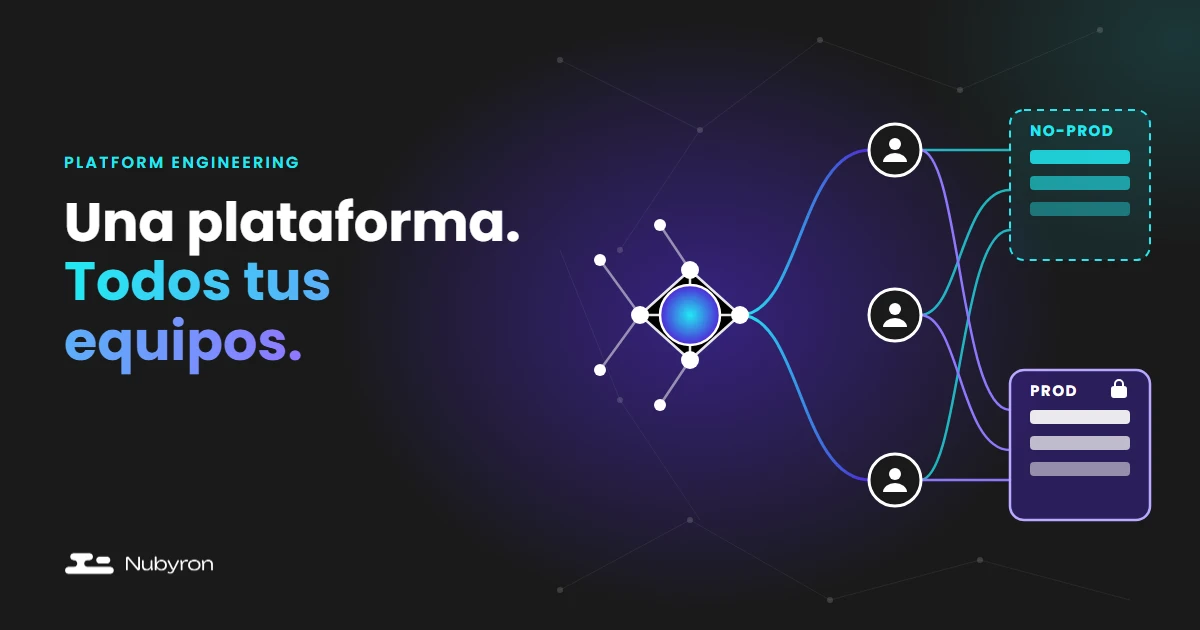
What platform engineering is
Platform engineering is a socio-technical discipline: it designs, builds and maintains an Internal Developer Platform (IDP) that teams use to take their software to production. “Socio” because it is not only about tooling: it is about how the people who build the platform and the people who use it work together.
The goal is easy to state: doing a deployment properly, securely and with cost under control should also be the easiest thing to do.
The four concepts behind it
The platform as a product. The platform team treats developers as its customers: it listens to what slows them down, prioritises, measures adoption and improves. A platform nobody adopts has solved nothing.
Golden paths (paved roads). Opinionated, supported workflows: from repository to production in a few steps, with tests, scanning and GitOps deployment already solved. Teams can leave the path, but they own the consequences.
Self-service. A team can request an environment, a pipeline or a space in the cluster without opening a ticket and waiting. The rules (quotas, policies, tags) ship inside the template instead of a manual review.
Lower cognitive load. The platform hides the complexity of infrastructure, Kubernetes and security policy so teams think about their product, not about how to configure an ingress.
What happens when a development team does not have one
This is not a Kubernetes failure (if you already run it, see how to read alerts and metrics without panic): it is what happens when the tool is adopted without designing how it will be used. These are common patterns, not data from any specific client:
Every team deploys its own way. Scripts, manual kubectl, Helm with no convention. A deployment depends on who runs it and who is on holiday.
Environments multiply and never switch off. Dev, test and staging run 24 hours a day even if used during working hours, and nobody owns switching them off.
One team affects another. Without quotas or limits, a runaway workload exhausts the nodes everybody shares.
Cost is opaque. The bill arrives per account or subscription, not per team or service, and nobody can answer “how much does team X cost?”.
Security is improvised. Long-lived credentials in CI, containers running as root, administrator permissions handed around. 5 DevSecOps controls to start with help here.
Everything goes through one person. Developers wait for “the Kubernetes person”, who becomes both a bottleneck and a continuity risk.
What you gain by having one
The benefits are qualitative and can be checked team by team. We do not promise percentages: they depend on where you start.
Smoother delivery: teams deploy without depending on a single person, with the same path and the same checks.
Visible cost: with tagging and per-team allocation, spend stops being one global number and gets owners.
Security by default: pod policies, default-deny networking, workload identity without static keys and secrets in the cloud vault, enforced by the template rather than by each team's memory.
Faster onboarding: a new team starts from a guide and templates, not from zero.
Less dependence on specific people: knowledge lives in the platform and its documentation.
Production and non-production: one platform, different rules
A well-designed platform does not treat every environment the same. Isolation is applied at the account, subscription, project or compartment level (depending on the cloud), because that is where identity, network and cost-allocation boundaries are set, not only in the cluster.
In production: its own space, deployment with approval and a dedicated role, and real data. In non-production (development, test and staging): infrastructure shared across environments, automatic deployment and synthetic or anonymised data; never copies of customer data.
Two pieces help a lot. Ephemeral environments create one environment per proposed change and destroy it automatically afterwards. And a realistic staging keeps the same Kubernetes version and policies as production, with less capacity and the option to switch it off when unused. The same image is promoted across environments; only configuration changes.
Several teams without the bill spiralling
Giving every team its own cluster is the simplest way to isolate them and also the most expensive: each cluster adds baseline capacity, operational work and, depending on the cloud and service tier, fixed control-plane charges. The practical rule is to pay only for the isolation that covers the real risk.
A common starting point, validated case by case, is one production cluster and one non-production cluster, with a namespace per team and quotas. Dedicated clusters are kept for regulatory requirements or risks that justify them, and virtual clusters for tests that need their own API.
The most common cost levers are switching non-production off outside working hours, using interruptible capacity (spot; preemptible on OCI) for workloads that tolerate interruptions, enabling node autoscaling, right-sizing resource requests and limits to real usage, putting an expiry on ephemeral environments, and allocating cost per team with tagging and tools such as OpenCost (see cloud cost optimisation).
An important caveat: all of this is potential savings. Real savings only exist once you measure before and after, so measurement should be designed in from the start.
When you do not need it, and how to start
Platform engineering is neither mandatory nor free: a platform without an owner ages, and an overly ambitious path does not get adopted. With few applications, nobody able to own the platform, or simple needs, managed services such as ECS/Fargate, Azure Container Apps, Cloud Run or App Service may be enough with less operational work. And Kubernetes is not the only possible foundation for an internal platform.
To start, keep it small: pick one deployment path and one application type, automate what hurts most, tag from day one and measure whether teams use it. Then expand. At Nubyron we design this kind of platform, with Kubernetes at the centre (Kubernetes and DevOps), for production and non-production environments on AWS, Azure, Google Cloud and OCI, and we deliver the architecture, reference code and guides so your teams can run it.
Frequently asked questions
What is an Internal Developer Platform (IDP)?
It is the set of tools, templates and automation that a platform team offers developers to create environments and to deploy and run their applications in a standardised, self-service way.
Do I need Kubernetes to do platform engineering?
Not necessarily. Kubernetes is a common foundation when there are many teams and services, but with few applications simpler managed services may be enough. The decision depends on the case, not on fashion.
How do you stop multi-team environments from driving up cost?
By sharing non-production infrastructure with per-team namespaces and quotas, switching off what is not used, using interruptible capacity for workloads that tolerate interruptions, right-sizing resources and allocating cost per team. It is potential savings until measured.
What is the difference between platform engineering and DevOps?
DevOps is a culture and set of practices for development and operations to work together. Platform engineering turns them into an internal product: a platform with golden paths and self-service that lowers teams' cognitive load. They are not alternatives: the platform is a way to apply DevOps at scale.
When is an internal developer platform worth building?
When several teams deploy their own way, environments multiply, cost is not allocated per team, or everything depends on one person. With few applications and small teams, a simpler managed service is usually enough.
Want a platform your teams can deploy on by themselves?
We design Kubernetes platforms for development teams, in production and in test, sharing infrastructure with cost kept visible.
We can review your case with you in a 30-minute conversation and tell you whether it makes sense, or whether something simpler is enough.
Talk to Nubyron